Blog
Zoom LiveTrak L6 Review 2026 | Price, Specs & Verdict | ProAudio Video

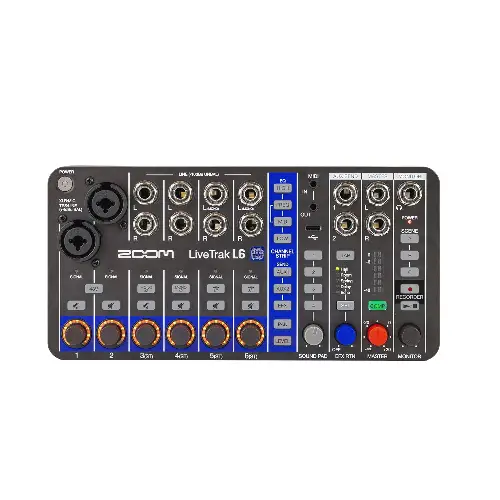
Zoom LiveTrak L6 Mixer + Recorder
The smallest 32-bit float digital mixer Zoom has ever built — 10 channels, 12-track recording and a USB interface in a 526 g box that runs on AA batteries.
The Zoom LiveTrak L6 is a 10-channel portable digital mixer, 12-track 32-bit float multitrack recorder and USB audio interface rolled into a single battery-powered unit that sells for ₹29,000 in India. It is the most compact member of Zoom’s LiveTrak family — smaller than the L-8, far smaller than the L-12 — and it is aimed squarely at the musician, synth player, streamer or small band who needs a real mixer with real faders but cannot justify carrying a rack case to every gig. Where most mixers at ₹29,000 in India give you analogue channel strips and nothing else, the L6 gives you a full digital channel strip, onboard effects, MIDI I/O, sound pads and clip-proof 32-bit float recording to microSD.
This review is for the Indian buyer weighing up a first serious mixer-recorder. The L6 makes most sense if you are a two-to-four-piece band recording rehearsals and live sets, a keyboard or modular synth player who wants a sub-mixer that also captures stems, a solo creator live-streaming to YouTube or Instagram from locations without mains power, or a home studio owner who wants one box that works as a desk on stage and an audio interface at the desk. If you need eight XLR preamps for a full podcast panel, this is the wrong unit — but for everyone else in that ₹29,000 bracket, the L6 is unusually well-specified for the money.
⚡ Quick Specifications at a Glance
✅ Pros
- 32-bit float recording removes gain-staging and clipping worries entirely
- 12 simultaneous record tracks (10 channels plus stereo mix) to microSD up to 2 TB
- Doubles as a 12-in / 4-out USB audio interface while still recording to card
- Runs on 4 AA batteries or USB power — genuinely location-ready at 526 g
- Full digital channel strip with 3-band mid-sweepable EQ, aux sends, pan and 5 send effects
❌ Cons
- Only 2 XLR mic inputs — not enough for a multi-mic podcast or drum kit
- Just 2 simultaneous playback tracks, so it is not a playback-heavy backing-track machine
- 48 kHz maximum sample rate only, with no 96 kHz option
Sound Quality and Recording Performance
The headline technology on the Zoom LiveTrak L6 is 32-bit float recording, and it changes how you work more than any spec sheet number suggests. The two XLR/TRS combo inputs use dual A/D converter circuits, which is why Zoom lists input gain as “adjustment unnecessary” — one converter handles quiet material, the other handles loud material, and the 32-bit float file stitches them together with enough headroom that clipping is effectively impossible. In practice this means you can point a mic at a snare drum, forget to set a level, and still recover a clean track in your DAW afterwards. For anyone recording live gigs in India where soundcheck time is measured in minutes, that safety net alone justifies a large chunk of the ₹29,000 price.
The measured performance backs up the convenience. Frequency response runs 20 Hz to 20 kHz within -1.0 dB, and equivalent input noise is rated at -120 dBu or less (IHF-A) at 150 Ω input, which is genuinely quiet for a mixer at this price. Maximum input level is +4 dBu on XLR and +24 dBu on TRS, so line-level synths and keyboards go straight in without a pad. Recording is 48 kHz, 32-bit float mono or stereo WAV, and the unit captures 12 tracks at once — the 10 discrete channels plus the stereo master mix — so you always have a usable live mix and the stems for later. Onboard you get five send effects including three reverbs, a delay and an echo, plus a master-bus compressor that adds loudness and a touch of natural saturation without any clipping risk. The 3-band EQ per channel gives you a 10 kHz shelving high, a sweepable 100 Hz to 8 kHz peaking mid, and a 100 Hz shelving low, all at ±15 dB.
Build Quality and Design
At 223 mm wide, 114 mm deep and 46.5 mm tall, the LiveTrak L6 is roughly the footprint of a hardback novel, and it weighs 526 g bare or 618 g with four AA batteries loaded. That is small enough to live permanently in a gig bag alongside a laptop, which is precisely the point. The chassis feels considerably more solid than the weight suggests, with a matte finish that resists fingerprints and a panel layout that stays legible in low stage light.
Rather than conventional faders, Zoom uses LED control knobs — rotary encoders ringed with LED indicators that show the current value at a glance. It is a compromise forced by the size, and mixing engineers used to throwing faders will need a session or two to adapt, but the LEDs make level positions readable across a dark stage in a way that small physical faders never are. Six-segment level meters sit above the channels. There are four assignable sound pads for triggering samples or backing tracks, and you can sample into them live during a jam. Three scene memories store your full mixer state and tempo settings for instant recall, which is invaluable if you play multiple sets or switch between rehearsal and streaming configurations. One genuinely clever design decision: the L6 mounts into a standard Eurorack case using the optional ERL-6 rack ears, making it one of the few mixers in India at ₹29,000 that modular synth players can bolt directly into their existing rig.
Features and Connectivity
Input-wise the LiveTrak L6 offers two XLR/TRS combo jacks with switchable +48 V phantom power for condenser microphones, plus four stereo TS inputs (eight TS phone jacks in total) for keyboards, synths, drum machines and other line sources. Two of those stereo pairs can be reconfigured as additional mono inputs if you need them. A USB audio return channel lets you bring backing tracks or laptop audio into the mix without occupying a physical input — useful for streamers running music beds. Outputs include two impedance-balanced mono AUX sends for monitor mixes or external effects, a balanced stereo MASTER output on TRS jacks (+15 dBu maximum), and a headphone MONITOR output with its own volume control delivering 50 mW per side into 63 Ω.
The USB-C port turns the L6 into a 12-in / 4-out audio interface at 32-bit float or 24-bit, 48 kHz, working with Windows, macOS, iOS and Android — and crucially it can act as an interface while simultaneously recording to the microSD card, so you have a hardware backup of every stream. It also functions as a DAW control surface and a USB card reader. MIDI I/O arrives on 3.5 mm jacks, letting you map volume, pan and EQ to outboard gear, trigger sound pads and scene changes, and tempo-sync the delay and echo effects. The free L6 Editor software opens up deeper MIDI programming, effect parameters and aux send point configuration from a computer. Power comes from four AA batteries (about 3 hours on alkaline, 3.5 hours on NiMH, roughly 7 hours on lithium), the bundled AD-17 USB adapter, or any USB power bank — the last of which is the realistic choice for long location days. In the box you get the L6, the AD-17 USB AC adapter and a USB-C cable; a microSD card is not included, so budget for a Class 10 or faster card.
Value for Money in India 2026
At ₹29,000 in India, the Zoom LiveTrak L6 sits in an awkward-to-shop bracket where most of what you find is either a basic analogue mixer with no recording at all, or a compact audio interface with no faders and no standalone operation. The L6 is both, plus a recorder, plus a MIDI hub. Compared against buying a separate small mixer and a 2-in audio interface, it comes out ahead on cost and dramatically ahead on portability. Against its own siblings the maths is equally clear: the Zoom LiveTrak L-8 costs ₹37,000 and the L-12 ₹58,000, so the L6 saves you ₹8,000 and ₹29,000 respectively while keeping the 32-bit float recording engine intact. What you give up is XLR count, not audio quality. For Indian musicians and creators whose sessions rarely need more than two microphones at once, that is a very sensible trade at ₹29,000.
Full Technical Specifications
| Specification | Details |
|---|---|
| Brand | Zoom |
| Model | LiveTrak L6 |
| Type | 10-Channel Digital Mixer / 12-Track Recorder / USB Audio Interface |
| Driver Size | N/A (mixer-recorder, no transducer) |
| Frequency Response | 20 Hz – 20 kHz / -1.0 dB |
| Impedance | Input: XLR 3.8 kΩ or more, TRS 39 kΩ or more, LINE 10 kΩ |
| Sensitivity | Equivalent input noise -120 dBu or less (IHF-A) at 150 Ω |
| Max SPL / Power | Max input +4 dBu (XLR) / +24 dBu (TRS); max output +15 dBu (MASTER); 5 W consumption |
| Connectivity | 2 XLR/TRS combo, 8 TS line jacks, 2 AUX sends, stereo MASTER, headphone out, USB-C, 3.5 mm MIDI In/Out, microSD |
| Battery Life | Approx. 3 h alkaline / 3.5 h NiMH / 7 h lithium (4 x AA); USB bus power supported |
| Weight | 526 g (unit only) / 618 g with batteries |
| Dimensions | 223 mm (W) x 114 mm (D) x 46.5 mm (H) |
| Colour Options | Black |
| Warranty | 1 Year Manufacturer Warranty |
| Price in India | ₹29,000 — Buy at ProAudio Video |
⚖️ How the Zoom LiveTrak L6 Compares
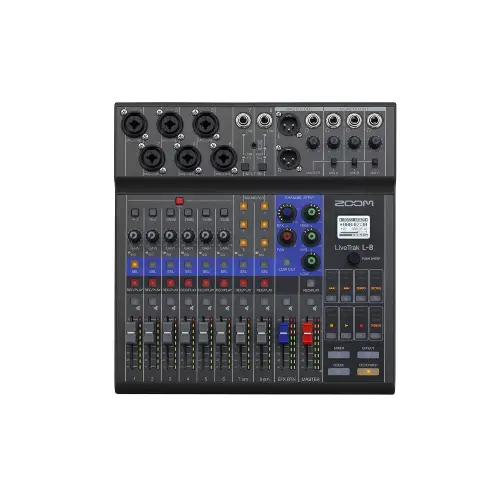
Zoom LiveTrak L-8
₹37,000
Six XLR inputs and built-in sound pads for podcast panels, but bigger, heavier and ₹8,000 more.
Zoom PodTrak P8
₹31,900
Purpose-built podcast recorder with six mic inputs and a touchscreen, but no MIDI and no stereo line channels.
Who Should Buy the Zoom LiveTrak L6?
✅ Buy it if you: play keys, synths or modular and need a compact sub-mixer that also records stems; gig with a small band and want every rehearsal and live set captured in 32-bit float without a soundcheck; live-stream from locations without reliable mains power and need battery operation; want one ₹29,000 device that serves as a stage mixer, a field recorder and a desktop USB audio interface.
❌ Skip it if you: need four or more XLR microphone inputs for a podcast panel or a drum kit; require 96 kHz or higher sample rates for post-production delivery specs; want to play back many backing tracks at once, since the L6 handles only two simultaneous playback tracks.
Frequently Asked Questions About the Zoom LiveTrak L6
What is the price of Zoom LiveTrak L6 in India?
The Zoom LiveTrak L6 is priced at ₹29,000 in India. You can buy it from ProAudio Video, one of India’s leading pro audio and video retailers, with fast delivery across India including Mumbai, Delhi, Bangalore, Hyderabad, Chennai, Kolkata and more.
Is the Zoom LiveTrak L6 good for live band recording?
Yes, for small bands. The L6 records 12 tracks simultaneously — all 10 channels plus the stereo master mix — in 32-bit float to microSD, so nothing clips even if levels jump mid-set. The limitation is that only two of those channels have XLR mic preamps, so a full drum kit needs an external preamp or a submixed feed.
What is the warranty on Zoom LiveTrak L6 in India?
The Zoom LiveTrak L6 comes with a standard 1-year manufacturer warranty in India. ProAudio Video provides after-sales support and can assist with warranty claims. Always check current warranty terms at purchase as these can change.
What are the best alternatives to Zoom LiveTrak L6 in India?
Top alternatives in the ₹29,000 to ₹40,000 range include the Zoom LiveTrak L-8 (₹37,000 — six XLR inputs and a larger control surface) and the Zoom PodTrak P8 (₹31,900 — podcast-focused with six mic inputs and a touchscreen). You can browse all mixer and recorder options at ProAudio Video.
Does ProAudio Video ship the Zoom LiveTrak L6 across India?
Yes, ProAudio Video ships the Zoom LiveTrak L6 to all major cities across India including Mumbai, Delhi, Bangalore, Pune, Hyderabad, Chennai, Ahmedabad, Kolkata and more. Order here for the best price and fast delivery.
Can the Zoom LiveTrak L6 be used as a USB audio interface while recording to SD card?
Yes. The L6 works as a 12-in / 4-out USB audio interface at 32-bit float or 24-bit, 48 kHz over USB 2.0, and it continues recording to the microSD card at the same time. That gives streamers and podcasters a hardware backup of every session independent of the computer, which is the single most useful redundancy feature at this price.
🏆 ProAudio Video Verdict
The Zoom LiveTrak L6 packs a genuinely professional feature set — 32-bit float recording, 12-track capture, a 12-in USB interface, MIDI control and battery operation — into the smallest LiveTrak body yet. The two-XLR limit is the one real compromise, but for synth players, small bands and mobile streamers in India, nothing else at ₹29,000 comes close on capability per gram.