Blog
Lenyes AA105 Rechargeable Battery Review 2026 | Price, Specs & Verdict | ProAudio Video

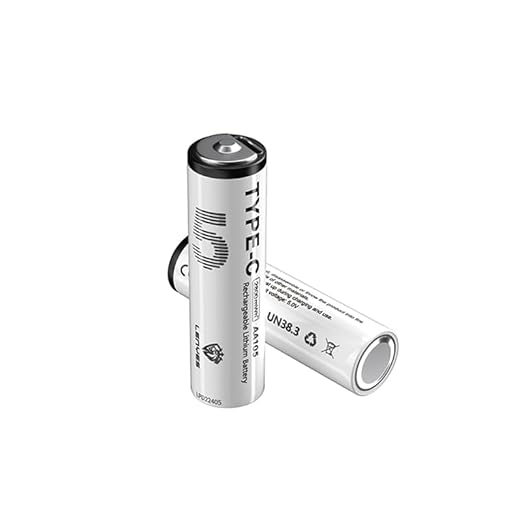
Lenyes AA105 USB-C Rechargeable Lithium AA Battery
A flat 1.5 V from full to empty, a USB-C port built into the cell itself, and 1,000+ recharge cycles — the practical answer for wireless mics and camera flashes that hate NiMH.
The Lenyes AA105 is a USB-C rechargeable lithium-ion AA battery that holds a constant 1.5 V output across its entire discharge cycle, priced at ₹1,800 in India. Where a conventional NiMH rechargeable starts at roughly 1.3 V and sags steadily as it drains, the AA105 uses a 3.7 V lithium cell paired with an internal buck regulator and Battery Management System to hold 1.5 V flat until it stops. It packs 2,800 mWh of energy into a standard AA form factor, is rated for over 1,000 recharge cycles, is BIS-certified for the Indian market, and charges from a USB Type-C port built directly into the cell body — no proprietary cradle, no external charger to lose.
This matters most to anyone running gear that is fussy about voltage. Wireless microphone transmitters, camera flashes and speedlights, wireless mice, digital audio recorders, guitar pedals and studio remotes are all devices that read 1.2 V NiMH cells as “nearly flat” and either display a false low-battery warning or refuse to deliver full performance. If you have ever put freshly charged Eneloops into a wireless mic pack and watched the battery meter show two bars, the AA105 is aimed squarely at you. At ₹1,800 in India it costs several times what a disposable alkaline four-pack does — but a single AA105 replaces roughly a thousand of them.
⚡ Quick Specifications at a Glance
✅ Pros
- Flat 1.5 V output from 100% to 0% — devices read a full battery right up until shutdown, unlike NiMH which sags from 1.3 V downwards
- USB-C port built into the cell itself; charge from a phone cable, laptop or power bank with no dedicated charger
- Rated for 1,000+ recharge cycles, roughly double the 500-cycle figure typically quoted for NiMH
- Negligible self-discharge as a lithium chemistry — leave it in a drawer for months and it is still ready
- BIS-certified for India, and eliminates the recurring cost and waste of disposable alkalines
❌ Cons
- Current delivery is the real limitation — USB-C lithium AA cells typically hold 1.5 V only below roughly 1.7 A and enter protection above about 2.4 A, where NiMH can supply far more
- Costs several times more per cell than NiMH or alkaline up front, so the savings are long-term rather than immediate
- When it does run out, it stops abruptly with no gradual voltage warning — you get no “battery is fading” cue mid-shoot or mid-set
Power Delivery & Real-World Performance
The defining characteristic of the Lenyes AA105 is voltage stability, and understanding why requires knowing what is actually inside. A standard AA alkaline starts near 1.5 V and declines continuously. A NiMH rechargeable such as an Eneloop has a nominal 1.2 V, opening around 1.3–1.4 V and falling from there. The AA105 instead contains a 3.7 V lithium-ion cell plus a regulator circuit that steps that down to a fixed 1.5 V. The result is a discharge curve that is essentially a flat line rather than a slope.
In practice this is the difference between a device working properly and a device complaining. Equipment that measures remaining charge by reading terminal voltage — which is most wireless microphone transmitters, most speedlights and most consumer electronics — interprets 1.2 V as a nearly dead alkaline. With the AA105 the meter reads full, because electrically it is full. For a sound engineer swapping transmitter packs between sets, or a wedding photographer whose flash recycle time depends on stable voltage, that consistency is the entire value proposition.
The honest counterpoint is peak current. Independent testing of USB-C lithium AA cells of this design shows they maintain 1.5 V while draw stays below roughly 1.7 A, with voltage falling away sharply beyond that and protection circuitry engaging around 2.4 A, at which point output can drop to about 1.15 V. A good NiMH cell will supply substantially more current before its voltage collapses. So for a very high-drain application — a professional speedlight firing at full power in rapid bursts — NiMH may still be the better electrical match. For wireless mics, recorders, remotes, mice, clocks and moderate-drain gear, the AA105’s 1,800 mAh and 2,800 mWh are more than sufficient and the flat voltage is a clear win.
Build Quality & Design
The AA105 is a true standard AA form factor, which sounds obvious but is the single most important physical requirement — it has to drop into an existing battery compartment without shimming or forcing. Lenyes has kept the dimensions to spec, so it seats correctly in wireless mic bodypacks, flash units and standard AA holders.
The headline design decision is the USB Type-C port moulded into the body of the cell. This removes an entire accessory from your kit bag. Anyone who has run a NiMH workflow knows the failure mode: the batteries are fine, but the charger is at home. With the AA105 any USB-C cable and any source — laptop, phone charger, power bank, the USB port on a mixer — becomes a charger. On location in India, where you may be working from a generator or a car, that flexibility genuinely matters.
Internally, the intelligent Battery Management System is doing the safety work: regulating voltage, preventing overcharge, and managing the cell within safe limits. Lithium chemistry demands that supervision, and its presence is the difference between a reputable cell and an unbranded one. Lenyes also holds BIS certification for the Indian market, which is worth confirming on any lithium product you buy here — uncertified lithium cells from grey-market sellers are a real safety concern, not a theoretical one. Buying from an authorised retailer such as ProAudio Video in India is the straightforward way to avoid that risk.
Features & Charging
Charging is deliberately uncomplicated. Plug a USB-C cable into the port on the cell, connect it to any USB power source, and the onboard BMS handles the rest — it regulates the charge and terminates when full, so overnight charging will not damage the cell. There is no cradle to buy, no four-bay charger to carry, and no risk of mismatching a charger to a chemistry.
Self-discharge is the quieter advantage. NiMH cells, even low-self-discharge designs, lose meaningful charge over months of storage. Lithium-ion loses very little, so an AA105 left in a spare kit bag between events should still be usable when you need it. For a rental house, a church AV team, or a photographer whose flash comes out once a month, this removes the “charge everything the night before” ritual.
Cycle life is rated at over 1,000 recharges. That figure deserves context: many NiMH manufacturers advertise around 500 cycles, and NiMH is additionally subject to a memory effect that rewards regular full discharge cycling to preserve capacity. Lithium-ion has no such requirement — partial charges are fine and do not degrade it. Over the life of one AA105, you are displacing roughly a thousand single-use alkaline cells, which is both a substantial cost saving in India and a meaningful reduction in battery waste going to landfill.
Value for Money in India 2026
At ₹1,800 — down from a ₹2,399 list price — the AA105 is not an impulse purchase, and it should not be evaluated as one. Compared against a NiMH cell it costs roughly two to three times as much, which is the standard premium for USB-C lithium AA cells. The correct comparison is against your actual running costs: if you are buying disposable alkalines for wireless mics or a flash on a regular basis in India, the payback period is short, and after that the AA105 is saving you money for another 900-plus cycles.
The value case is strongest for pro audio and video users specifically, which is exactly the audience this product suits. If your gear misbehaves on 1.2 V NiMH, no amount of NiMH capacity fixes that — you are buying the AA105 to solve a voltage problem, and it solves it completely. If your devices are perfectly happy on NiMH and you need maximum peak current, a good Eneloop set remains the better technical and financial choice. Know which situation you are in before you spend ₹1,800.
Full Technical Specifications
| Specification | Details |
|---|---|
| Brand | Lenyes |
| Model | AA105 |
| Type | Rechargeable lithium-ion AA battery with integrated USB-C charging |
| Driver Size | N/A — battery, not an audio transducer; standard AA form factor |
| Frequency Response | N/A — DC power cell |
| Impedance | N/A — low internal resistance Li-ion cell with regulator circuit |
| Sensitivity | N/A |
| Max SPL / Power | 2,800 mWh energy; 1,800 mAh capacity; constant 1.5 V regulated output |
| Connectivity | USB Type-C charging port integrated into the cell body |
| Battery Life | Over 1,000 recharge cycles; negligible self-discharge in storage |
| Weight | Standard AA cell weight class (approx. 20–25 g per cell) |
| Dimensions | Standard AA form factor (approx. 50.5 × 14.5 mm) |
| Colour Options | Single finish as supplied |
| Warranty | 1 Year Manufacturer Warranty |
| Price in India | ₹1,800 — Buy at ProAudio Video |
⚖️ How the Lenyes AA105 Compares
Panasonic Eneloop Pro
₹1,500 approx.
NiMH at 1.2 V — higher peak current for demanding flashes, but needs an external charger and reads as low battery in voltage-sensing gear.
Standard Alkaline AA
₹100–200 per pack
Cheapest up front and highest long-run cost — single use, voltage declines continuously, and thousands end up as landfill waste.
Who Should Buy the Lenyes AA105?
✅ Buy it if you: run wireless microphone transmitters, camera flashes, digital recorders or remotes that show a false low-battery warning on 1.2 V NiMH cells; want to charge from any USB-C cable without carrying a dedicated battery charger to gigs and shoots across India; are replacing disposable alkalines frequently and want the running cost to stop; need cells that hold charge reliably in storage between infrequent events.
❌ Skip it if you: need very high peak current for professional speedlights firing rapid full-power bursts, where NiMH still delivers more before voltage collapses; are equipping a large number of low-drain devices such as clocks and TV remotes, where ₹1,800 per cell makes no economic sense; specifically want a gradual low-battery warning, since lithium cells cut off abruptly with no fade.
Frequently Asked Questions About the Lenyes AA105
What is the price of Lenyes AA105 in India?
The Lenyes AA105 is priced at ₹1,800 in India, reduced from a list price of ₹2,399. You can buy it from ProAudio Video, one of India’s leading pro audio and video retailers, with fast delivery across India including Mumbai, Delhi, Bangalore, Hyderabad, Chennai, Kolkata and more.
Is the Lenyes AA105 good for wireless microphones and camera flashes?
Yes, particularly for wireless microphones. Because it holds a constant 1.5 V rather than NiMH’s 1.2 V, transmitter battery meters read correctly and the device performs as it would on a fresh alkaline. For camera flashes it works well at moderate drain, but professional speedlights firing rapid full-power bursts draw current beyond where these cells hold voltage, so NiMH may suit that specific case better.
What is the warranty on Lenyes AA105 in India?
The Lenyes AA105 comes with a standard 1-year manufacturer warranty in India. ProAudio Video provides after-sales support and can assist with warranty claims. Always check current warranty terms at purchase as these can change.
What are the best alternatives to Lenyes AA105 in India?
Top alternatives in the ₹150–₹1,800 range include Panasonic Eneloop Pro NiMH cells (₹1,500 approx. — higher peak current but 1.2 V and needs an external charger) and standard disposable alkaline AAs (₹100–200 per pack — cheapest up front, far more expensive and wasteful over time). You can browse all battery options at ProAudio Video.
Does ProAudio Video ship the Lenyes AA105 across India?
Yes, ProAudio Video ships the Lenyes AA105 to all major cities across India including Mumbai, Delhi, Bangalore, Pune, Hyderabad, Chennai, Ahmedabad, Kolkata and more. Order here for the best price and fast delivery.
Why does the AA105 give 1.5 V when a lithium cell is 3.7 V, and can I overcharge it?
The AA105 contains a 3.7 V lithium-ion cell with a built-in buck regulator that steps the output down to a fixed 1.5 V, which is why the voltage stays flat instead of sloping down like NiMH. An intelligent Battery Management System governs charging, regulates voltage and terminates the charge when the cell is full, so leaving it plugged into USB-C overnight will not overcharge or damage it.
🏆 ProAudio Video Verdict
The Lenyes AA105 solves one problem exceptionally well: it gives voltage-sensitive gear a genuine, unwavering 1.5 V, and it charges from the USB-C cable already in your bag. Peak current is its ceiling and ₹1,800 is a real up-front cost, but for wireless mics, recorders and moderate-drain pro AV equipment in India it is the smarter long-term buy.