Universal Audio Volt 1 Review 2026 | Price, Specs & Verdict | ProAudio Video
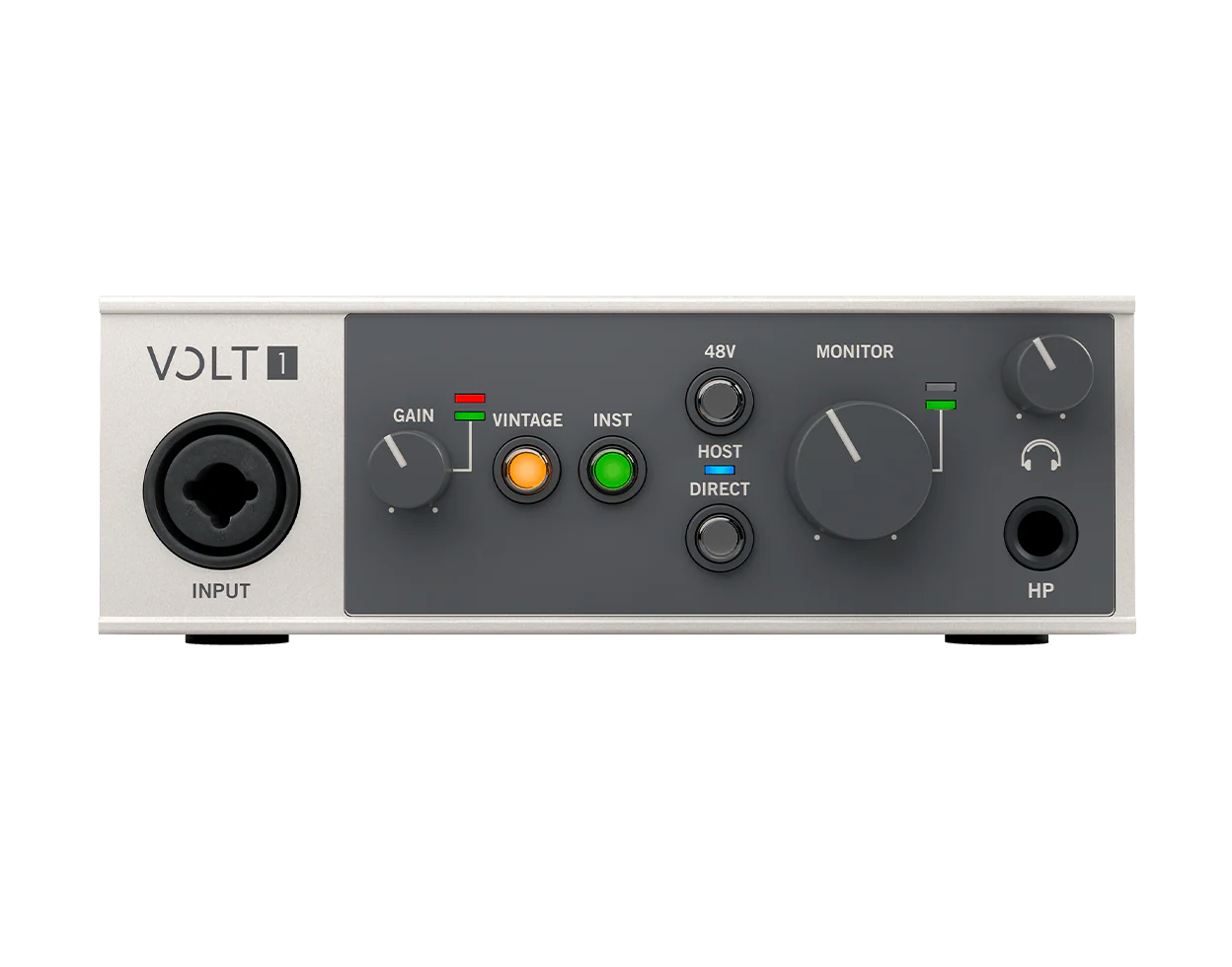
Universal Audio Volt 1
A one-input USB-C interface with 24-bit/192kHz conversion and a Vintage tube-preamp mode borrowed from UA’s legendary 610 — the singer-songwriter’s dream at an entry price.
Universal Audio Volt 1 is a compact 1-in/2-out USB-C audio interface that brings the famous “UA sound” to home studios, podcasters and mobile creators for just ₹16,250 in India. Where most budget interfaces simply digitise your signal cleanly, the Volt 1 adds a switchable Vintage Mic Preamp Mode that emulates the warm, gently saturated character of Universal Audio’s classic 610 tube preamp — the same lineage found on countless hit records. Combined with true 24-bit/192 kHz conversion, a single studio-grade mic/instrument input, and bus-powered USB-C connectivity for Mac, PC, iPad and iPhone, it is one of the most characterful ways to start recording without spending a fortune. For anyone who wants their first interface to sound like a professional studio rather than a clinical dongle, the Volt 1 is a compelling pick.
This review is aimed at the solo singer-songwriter, the guitarist tracking one part at a time, the podcaster or voice-over artist recording a single microphone, and the mobile musician who wants to capture ideas on an iPad. If you only ever record one source at a time and value tone and simplicity over channel count, the Volt 1 is purpose-built for you — and this guide breaks down exactly what you get for your ₹16,250 in 2026.
⚡ Quick Specifications at a Glance
✅ Pros
- Vintage preamp mode adds real analog warmth to vocals
- True 24-bit/192 kHz studio-grade conversion
- Bus-powered USB-C works with Mac, PC, iPad and iPhone
- Rugged metal-topped build feels premium for the price
- Generous bundled software to start recording day one
❌ Cons
- Only one input — no stereo or two-mic recording
- No onboard DSP or UAD plugin processing
- Focusrite’s rival adds “Air” mode at a similar price
Sound Quality & Performance
The heart of the Volt 1 is its custom analog mic/line preamplifier paired with optimised 24-bit/192 kHz conversion. In normal mode the preamp is clean, quiet and detailed, capturing vocals and acoustic guitar with true-to-life clarity and plenty of headroom. Flip the Vintage switch and the character changes: the circuit emulates Universal Audio’s legendary 610 tube preamp, introducing gentle harmonic saturation and a subtle treble lift that adds richness, body and a flattering sheen to voices and instruments. It is a genuinely useful tonal option rather than a gimmick — the kind of colour producers normally chase with expensive outboard gear.
For a single-channel interface at this price, the measured performance is excellent, delivering the dynamic range and low noise floor you need for professional-sounding recordings. Zero-latency direct monitoring lets performers hear themselves in real time while tracking, preserving timing and feel with no distracting delay. Whether you are recording intimate vocal takes, DI guitar, a podcast voice, or a soft synth, the Volt 1 captures it with dimensionality and warmth that punches above its ₹16,250 asking price in India.
Build Quality & Design
The Volt 1 follows Universal Audio’s retro-inspired design language, with a clean, utilitarian faceplate and a robust metal top panel that feels reassuringly solid on a desk. It is compact and light enough to slip into a laptop bag, making it a natural fit for mobile recording, yet it does not slide around during use. The large central gain knob and clearly laid-out controls make level-setting intuitive even for first-time users, and the front-panel headphone output with its own volume control is perfectly placed for quick monitoring.
Connections are sensible and modern: a single XLR/TRS combo input on the front handles microphones, line sources and Hi-Z instruments like electric guitar or bass, while the rear carries balanced 1/4-inch monitor outputs and the USB-C port. Because the unit is bus-powered over USB-C, there is no external power brick to carry — one cable handles both data and power. The overall impression is of a purpose-built tool that looks like vintage studio gear but is engineered for the realities of a modern desktop or on-the-go setup in India.
Features & Connectivity
Connectivity is where the Volt 1 shows its clever entry-level focus. The single combo input accepts a microphone (with switchable +48V phantom power for condensers), a line signal, or a high-impedance instrument, so a vocalist, a podcaster and a guitarist are all covered by the same jack. Two balanced TRS outputs feed studio monitors, and the dedicated headphone output ensures you can track and mix in isolation. The USB-C connection is class-compliant and bus-powered, working seamlessly with Windows 10 and later, macOS 10.14 and later, and — crucially for creators on the move — iOS 14 and later, so you can record directly to an iPad or iPhone.
Universal Audio also sweetens the deal with a substantial bundled software suite that typically includes a DAW plus a curated collection of virtual instruments and effects, giving newcomers everything they need to make a finished track from the moment they unbox. The trade-off compared with UA’s pricier Apollo range is that the Volt 1 does not run onboard UAD DSP plugins — all processing happens on your computer. For its target buyer that is entirely reasonable: you get the tone and the workflow of a UA product at a fraction of the cost, and you can always add plugins in your DAW as your skills grow.
Value for Money in India 2026
At ₹16,250, the Universal Audio Volt 1 sits in a sweet spot for Indian home recordists in 2026. It costs more than a bare-bones interface like the Behringer UM2 but delivers dramatically better conversion, build quality, a bundled software package, and — most importantly — that unique Vintage preamp character no rival at this price can match. Against the Focusrite Scarlett Solo 4th Gen, the decision comes down to flavour: Focusrite’s “Air” mode brightens and opens up a sound, while UA’s Vintage mode adds warmth and saturation. For singer-songwriters, podcasters and solo creators who want their recordings to sound rich and finished with minimal fuss, the Volt 1 offers standout value and a genuine slice of Universal Audio heritage for well under ₹20,000.
Full Technical Specifications
| Specification | Details |
|---|---|
| Brand | Universal Audio |
| Model | Volt 1 |
| Type | 1-in / 2-out USB-C Audio Interface |
| Inputs | 1x XLR/TRS combo (mic / line / Hi-Z instrument) |
| Resolution / Sample Rate | 24-bit / up to 192 kHz |
| Outputs | 2x 1/4″ TRS balanced monitor outputs + 1x 1/4″ headphone output |
| Preamp | Custom analog preamp with switchable Vintage Mode (UA 610 emulation) |
| Phantom Power | +48V (for condenser microphones) |
| Connectivity | USB-C (USB 2.0), bus-powered |
| Compatibility | Windows 10+, macOS 10.14+, iOS 14+ (iPad / iPhone) |
| Weight | Approx. 0.6 kg (compact desktop unit) |
| Dimensions | Compact desktop chassis |
| Colour Options | Black |
| Warranty | 1 Year Manufacturer Warranty |
| Price in India | ₹16,250 — Buy at ProAudio Video |
⚖️ How the Volt 1 Compares
Focusrite Scarlett Solo 4th Gen
₹18,900
Similar 1-mic interface with bright “Air” mode instead of vintage tube warmth.
Behringer U-Phoria UM2
₹7,999
Much cheaper 2×2 interface, but basic sound and no character preamp mode.
Who Should Buy the Universal Audio Volt 1?
✅ Buy it if you: are a singer-songwriter or podcaster who records one microphone at a time; want real analog-style warmth from the Vintage 610 preamp mode; need a bus-powered interface that works with an iPad or iPhone as well as a laptop; or want a bundled software package so you can start recording immediately.
❌ Skip it if you: need to record two sources at once, such as a stereo pair or a vocalist plus guitar simultaneously (choose the Volt 2 instead); rely on onboard DSP or UAD plugin processing; or prefer a brighter, more open tonal character, in which case the Focusrite Scarlett Solo is worth considering.
Frequently Asked Questions About the Universal Audio Volt 1
What is the price of the Volt 1 in India?
The Universal Audio Volt 1 is priced at ₹16,250 in India. You can buy it from ProAudio Video, one of India’s leading pro audio and video retailers, with fast delivery across India including Mumbai, Delhi, Bangalore, Hyderabad, Chennai, Kolkata and more.
Is the Volt 1 good for podcasting and vocals?
Yes. The Volt 1 is ideal for single-mic podcasting and vocal recording. Its clean 24-bit/192 kHz conversion captures a voice with clarity, while the Vintage preamp mode adds warmth and richness. With +48V phantom power it also drives studio condenser microphones with ease.
What is the warranty on the Volt 1 in India?
The Universal Audio Volt 1 comes with a standard 1-year manufacturer warranty in India. ProAudio Video provides after-sales support and can assist with warranty claims. Always check current warranty terms at purchase as these can change.
What are the best alternatives to the Volt 1 in India?
Top alternatives in the ₹8,000–₹19,000 range include the Focusrite Scarlett Solo 4th Gen (₹18,900 — bright “Air” mode) and the Behringer U-Phoria UM2 (₹7,999 — budget 2×2). You can browse all audio interface options at ProAudio Video.
Does ProAudio Video ship the Volt 1 across India?
Yes, ProAudio Video ships the Volt 1 to all major cities across India including Mumbai, Delhi, Bangalore, Pune, Hyderabad, Chennai, Ahmedabad, Kolkata and more. Order here for the best price and fast delivery.
Does the Volt 1 work with an iPad or iPhone?
Yes. The Volt 1 is class-compliant and bus-powered over USB-C and is compatible with iOS 14 and later, so it works directly with an iPad or iPhone (a compatible USB-C cable or adapter may be needed), as well as Windows 10+ and macOS 10.14+ computers — making it a genuinely portable recording solution.
🏆 ProAudio Video Verdict
The Universal Audio Volt 1 delivers genuine UA tone, studio-grade 24-bit/192 kHz conversion and a characterful Vintage preamp mode in a rugged, portable, bus-powered package. For solo singer-songwriters and podcasters in India, it is one of the best-value first interfaces you can buy in 2026.