
· Updated
The Complete Home Theatre Buying Guide in India (2026)
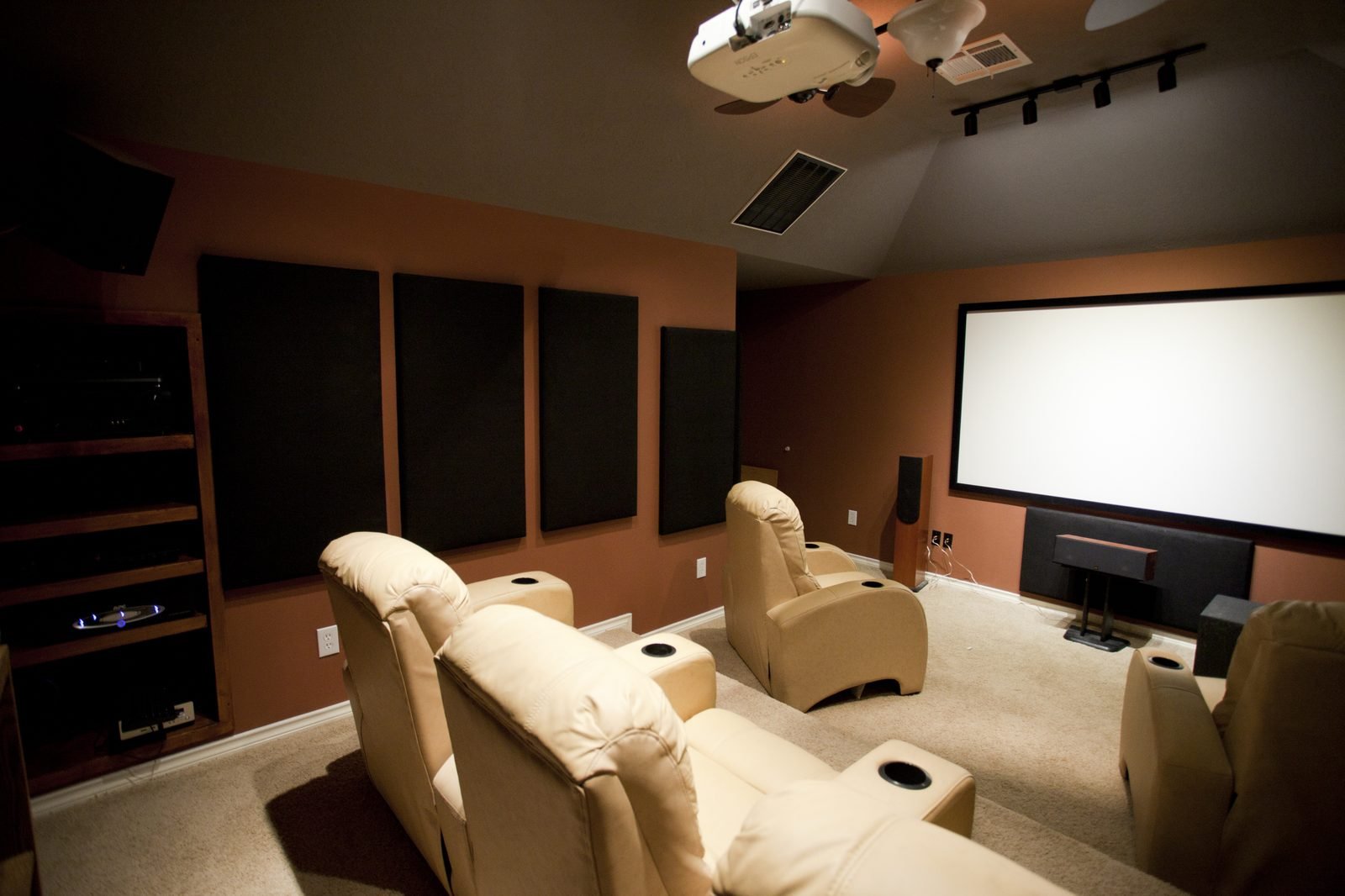
A home theatre is not one product. It is a system: speakers placed around you, something to drive them, something to play the film, and a screen big enough to make it feel like a cinema. Buy the parts in the wrong order, or buy channels your room cannot place, and even good equipment sounds ordinary. Buy them to match your room, and a modest system can sound superb.
This guide explains the whole thing in plain language: what 2.1, 5.1, 7.1 and Dolby Atmos actually mean, what an AV receiver does, why the centre speaker and the subwoofer matter more than most people expect, where to put everything, and how to buy in India without falling for grey-market traps. No prices, no model recommendations — those change constantly. What does not change is how the system works, and that is what this guide covers.
The short version: which system for which room
If you only remember one section, remember this one. Match the system to the room, not to the specification sheet.
- Small room or bedroom, one sofa, TV on a console: a good soundbar, or a 2.1 system (two speakers and a subwoofer). You get clear dialogue and real bass without speakers you have nowhere to put.
- Typical living room, sofa 3 to 4 metres from the TV: a 5.1 system. This is the sweet spot for most Indian homes — genuine surround sound, a proper centre speaker for dialogue, and a subwoofer for films.
- Large living room or a dedicated media room with space behind the sofa: a 7.1 system, or a Dolby Atmos system with height speakers. These need room behind and above you; without that space, the extra channels have nowhere to go.
The rest of this guide explains why that is, so you can judge any system — soundbar, speaker package or separates — against your own room.
Understanding the numbers: 2.1, 5.1, 7.1 and beyond
The numbers describe how many speakers and subwoofers a system has. The first number counts the full-range speakers at ear level. The number after the point counts subwoofers. A third number, when there is one, counts height speakers.
- 2.1: two speakers (left and right) plus one subwoofer. Stereo sound with proper bass. Excellent for music and a big step up from TV speakers, but no surround effect — sound comes from the front only.
- 5.1: five speakers plus one subwoofer — front left, front right, centre, surround left and surround right. The centre carries most of the dialogue, the fronts carry music and effects, and the surrounds carry ambience and movement around you. This is the standard film mix format, and the most common home theatre layout in the world.
- 7.1: seven speakers plus one subwoofer. It adds two surround-back speakers behind you, so sounds can move from beside you to behind you. It only works if there is real space behind your seat — in a sofa pushed against the wall, the rear speakers end up beside your ears and add little.
- 5.1.2 or 7.1.4: the same layouts with height speakers added — 2 or 4 speakers above you. That third number is what makes a system a Dolby Atmos system.
- 5.2 or 7.2: the “2” means two subwoofers instead of one. Two subwoofers bring two different benefits. First, output headroom: two drivers and two amplifiers share the load, so each works less hard, with less distortion and compression at high volumes — and two co-located subwoofers behave largely like one louder source. Second, smoother bass across seats: when placed apart and calibrated as a system, multiple subwoofers excite room modes differently and reduce the seat-to-seat variation that makes bass boomy in one chair and thin in the next. Research from Harman on multiple subwoofers supports this second benefit, but it is not automatic — placement and calibration decide whether a second subwoofer smooths the response or simply adds output.
A useful reference for the standard 5.1 layout is the 5.1 surround sound channel guide, which shows exactly which speaker does what.
Dolby Atmos explained: sound above you, not just around you
Traditional surround sound assigns sounds to channels: this sound goes to the left surround speaker, that sound to the right. Dolby Atmos works differently. Sounds are treated as objects placed in three-dimensional space, and your system works out which speakers should play them — including speakers above you. A helicopter can genuinely pass overhead instead of just getting louder in the side speakers.
Height sound reaches you in three ways. Ceiling speakers are the best: speakers mounted in or on the ceiling, firing down — in a four-height layout, the front pair sits ahead of the listening position and the rear pair behind it, each aimed at the listener. Upfiring modules sit on top of your front speakers (and sometimes surrounds) and bounce sound off a flat ceiling; they work best with flat ceilings of ordinary height (around 8 to 9 feet), and poorly with very high, sloped or heavily beamed ceilings. Soundbars with upfiring drivers, like the ones in our Bose Lifestyle Ultra review and Sonos Arc Ultra review, do the same trick from a single cabinet. Ceiling speakers are the most accurate; upfiring drivers are the practical option where the ceiling cannot be opened.
Two practical points about Atmos content. First, streaming services carry Atmos in a compressed form (Dolby Digital Plus), while Blu-ray and 4K discs carry it losslessly (Dolby TrueHD). Both are genuine Atmos; the disc version simply has more audio data. Second, lossless Atmos from a TV needs an HDMI eARC connection between the TV and the soundbar or receiver — ordinary ARC can carry Atmos only in its compressed Dolby Digital Plus form, not the lossless TrueHD version. eARC is part of the HDMI 2.1 specification, and it only works when the TV, the soundbar or receiver, and the cable all support it. If your TV only has ARC, connect the player directly to the receiver or soundbar instead — that path carries the lossless track without needing the TV’s return channel at all.
Atmos is also not the only object-based format — DTS:X works on the same idea — but Atmos has the most content on streaming services, so it is the format most buyers should plan around.
The AV receiver: the heart of a separates system
If you buy separate speakers, you need an AV receiver. It does four jobs. It decodes the soundtrack (Dolby Digital, Dolby Atmos, DTS and the rest) into individual channels. It amplifies those channels — one amplifier per speaker, all in one box. It switches your sources: set-top box, streaming stick, Blu-ray player, game console, all connected by HDMI, with one HDMI cable going to the TV. And it calibrates the system to your room, using a supplied microphone to measure speaker distances, levels and frequency response, then correcting them automatically. Every major brand has its own calibration system, and running it is the single most effective free upgrade any home theatre owner can do — yet it is the step most often skipped. Calibration is powerful but not magic: it aligns levels, timing and response, but it cannot fix a deep bass null at your seat, a speaker buried in a closed cabinet, or a bare reflective room — those need placement and furnishing first.
When choosing a receiver, count amplified channels, not watts — and read the channel numbers correctly. The first number is the count of speakers the receiver can amplify. The number after the point is the count of subwoofer outputs, which are line-level pre-outs, not amplified channels: a “7.2-channel” receiver amplifies seven speakers and provides two subwoofer outputs, and on many receivers those two outputs carry the same signal, while higher-end models calibrate them independently. A 9-channel receiver amplifies nine speakers, which can be configured as 5.1.4 (five ear-level speakers, one subwoofer, four height speakers) or 7.1.2 (seven ear-level speakers, one subwoofer, two height speakers) — both are nine amplified channels plus a subwoofer output, and which suits you depends on whether your room has space behind the sofa (for the extra surrounds of 7.1.2) or above it (for the extra heights of 5.1.4). Both configurations appear in an SVS overview of Dolby’s recommended home Atmos layouts. Buy the amplified channel count your room can actually place — channels you cannot place are wasted. After channels, check the HDMI inputs: enough for your sources, with eARC on the TV output for lossless Atmos, and support for the video formats your TV uses. Pre-outs — outputs that let you add a separate power amplifier later — are worth having if you plan to upgrade to demanding speakers one day. You can browse the current range of AV receivers at Pro Audio Video to see how channel counts and features differ.
The speakers: front, centre and surrounds each have a job
Front left and right carry music, effects and much of the soundtrack, and they do double duty for stereo music listening. Tower (floor-standing) speakers suit larger rooms and play deeper on their own; compact bookshelf speakers suit smaller rooms and rely on the subwoofer for bass. Our tower speaker guide goes deeper on choosing between them, including room size and amplifier matching.
The centre speaker is the most important speaker in a film system, and the most underestimated. It carries most of the dialogue and much of the on-screen action. A weak or mismatched centre is why dialogue sounds muffled on so many systems. Choose the centre from the same brand and series as your front speakers if you can — matched speakers keep voices and effects sounding consistent as they move across the screen. See the range of centre channel speakers for the options.
Surround speakers carry ambience, crowd noise, rain, and sounds that move around you. They do not need to be as large as the fronts — compact speakers work well here — but they should be from a similar family for a consistent sound. In finished rooms, in-wall and on-wall speakers keep surrounds neat: in-wall models sit flush behind a paintable grille and suit rooms being built or renovated, while on-wall models hang on a bracket and suit rented homes and brick walls where cutting is not practical.
The subwoofer: why the “.1” matters more than its size suggests
The subwoofer handles the lowest sounds: explosions, the rumble of an engine, the bottom octave of music. It also takes the bass load off your other speakers, which lets them play cleaner and louder. A system without a subwoofer can sound thin on films even with large front speakers, because film soundtracks put their deepest effects on a dedicated low-frequency channel that only a subwoofer reproduces properly.
Two designs dominate. Sealed subwoofers are typically smaller and tighter-sounding, and suit music as well as films. Ported subwoofers use a vent to play deeper and louder for their size, and suit large rooms and film-first systems. Neither is better in general; the right choice depends on your room size and whether music or films come first. Placement matters as much as the model: a corner boosts output but can make bass boomy and uneven, while the middle of a wall is often smoother. The reliable method is the “subwoofer crawl”: put the subwoofer where you sit, play bass-heavy content, crawl around the room listening for where the bass sounds most even, and put the subwoofer there. It looks odd and it works. Browse the subwoofer range to compare sealed and ported designs.
Speaker placement: the free upgrade
Placement is free, and it changes the sound more than most equipment upgrades. The standard reference is the ITU-R BS 775 layout used for 5.1: the centre speaker at 0 degrees (dead ahead), the front left and right at roughly 22 to 30 degrees either side of your viewing direction, and the surrounds at roughly 110 degrees — beside you and slightly behind. Keep all speakers roughly the same distance from your seat where the room allows, and let the receiver’s calibration fine-tune the rest.
- Front speakers: form an even triangle with your seat — the same distance apart as they are from you, roughly — and angle them slightly inward toward your ears. Keep them out from the back wall if they are rear-ported; a few tens of centimetres of breathing room tightens the bass noticeably.
- Centre speaker: directly above or below the screen, as close to ear height as possible, angled toward your ears if it sits low. A centre buried inside a closed cabinet sounds muffled; if it must go in furniture, pull it to the front edge and leave the front open.
- Surround speakers: to your sides and slightly behind, a little above ear height when seated. Speakers directly behind a sofa that touches the wall cannot do their job — in that case, side placement is better than rear placement.
- Height speakers: overhead, slightly in front of and behind the seat for a four-speaker Atmos layout, or above the front speakers for a two-speaker layout. Upfiring modules need a flat, reflective ceiling and a clear path to it — ceiling fans and beams in the bounce path weaken the effect.
- All speakers: tweeters at seated ear height is the target for ear-level speakers. On Indian marble and tile floors, use the supplied spikes or feet to stop cabinets rocking, and a rug between the speakers and the sofa tames the floor reflections that make dialogue harsh.
Soundbar vs separates: an honest comparison
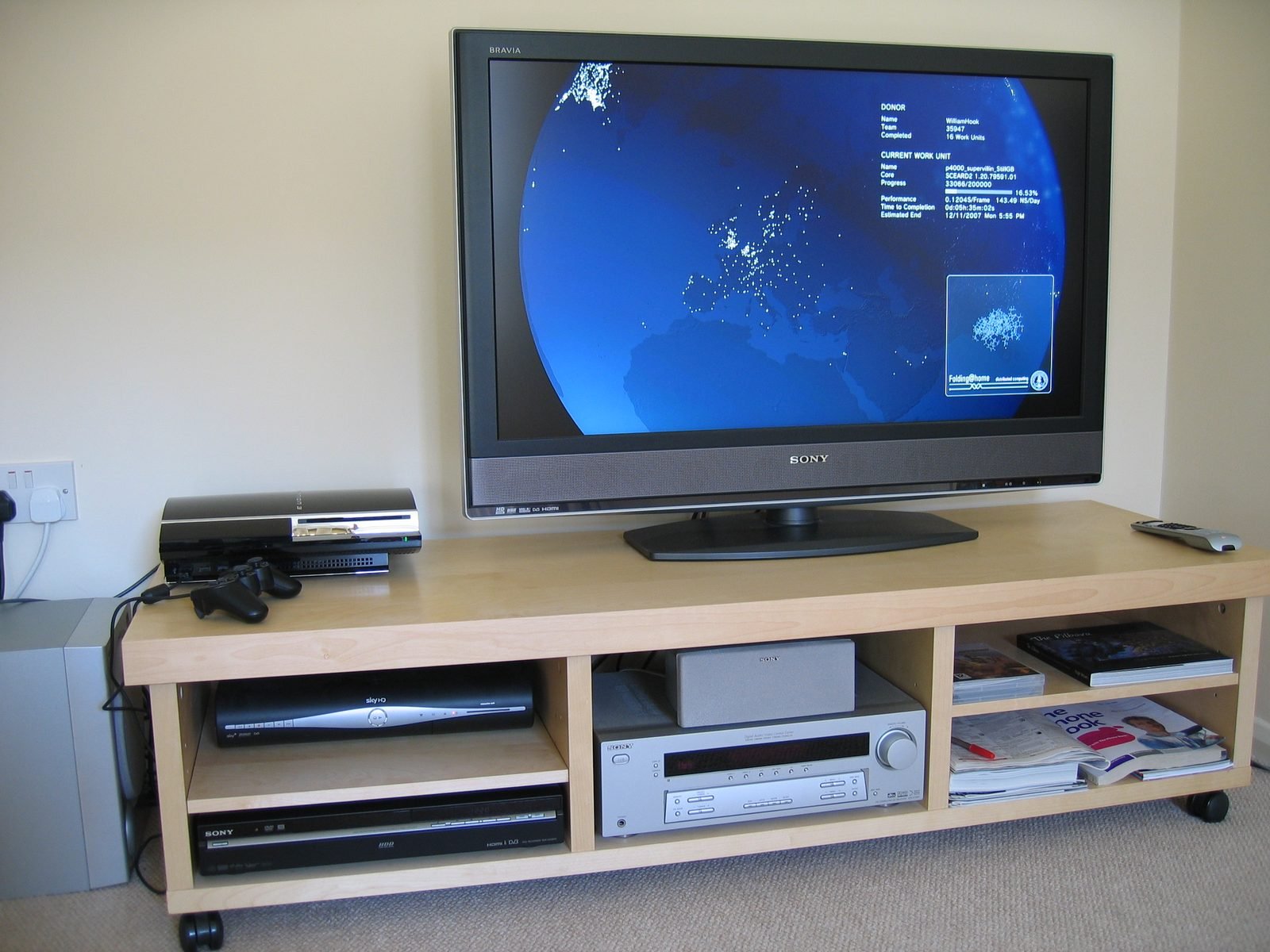
A soundbar is one slim speaker under the TV, usually with a wireless subwoofer and sometimes wireless rear speakers. It connects with a single HDMI cable, needs almost no setup, and the best ones produce genuine Atmos height effects. For most living rooms, a good soundbar is the sensible answer — and the reason soundbars dominate is that they remove every obstacle between buying and enjoying: no receiver to configure, no speaker cable to run, no placement puzzle. You can compare the current soundbar range to see how far they go, from compact bars to full systems with rears and a sub.
Separates — a receiver and individual speakers — win on three things: real speaker positions (a rear speaker behind you beats a soundbar pretending there is one), power and scale in large rooms, and upgradeability (swap the fronts this year, add height speakers next year, keep the receiver). They lose on simplicity, space and setup effort. A practical path many buyers take is to start with a soundbar and move to a separates system later, or to buy a complete matched speaker package — fronts, centre, surrounds and subwoofer chosen to work together — which removes the hardest part of separates buying, which is matching speakers to each other.
Screen and room: the picture half of the cinema
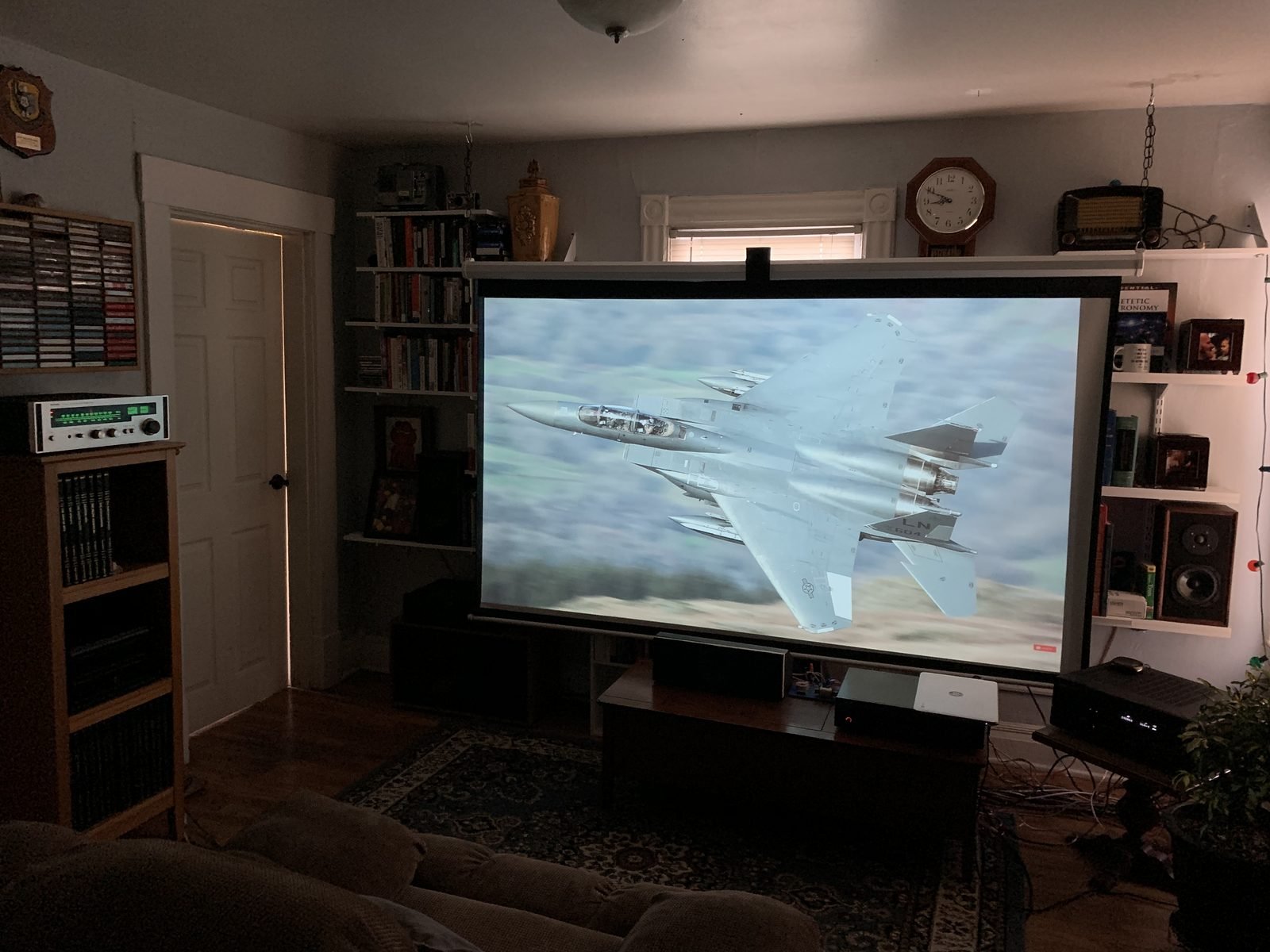
Sound is half the system; the screen is the other half. A television is simpler and works in bright rooms. A projector gives a far larger image — 100 inches and beyond — but needs light control to look its best. If you go the projector route, the screen matters as much as the projector: a proper screen gives a brighter, sharper and more uniform picture than a painted wall. Fixed-frame screens suit dedicated rooms; motorised screens disappear into the ceiling and suit living rooms; ambient-light-rejecting (ALR) screens suit rooms you cannot darken. Our projector screen guide covers sizes and materials in detail.
As a rough seating guide, sit about 1 to 1.5 times the screen width away for a 4K image — closer than most people expect, and the reason a big screen works even in a medium room. For the room itself, soft furnishings are your friend: curtains, a rug, a fabric sofa and bookshelves all absorb reflections that otherwise make dialogue harsh and bass muddy. You do not need a treated studio; a normally furnished living room with a rug and curtains already sounds far better than a bare room with marble floors and glass walls.
Buying a home theatre in India: what to check before you pay
Buy authorised, with a GST invoice. The Indian market has a large grey channel: imported units sold without Indian warranty, sometimes at tempting prices. An authorised unit comes with Indian warranty and local service; a grey unit can leave you with no repair route at all. Always ask for a GST invoice and confirm the warranty is the manufacturer’s Indian warranty, not a seller-only promise. This matters more than any small price difference, because a home theatre is a system you expect to keep for years.
Audition before you buy. Specifications and reviews can narrow the choice, but speakers sound different in different rooms, and your ears are the final judge. Bring content you know well — a film scene and a song you have heard a hundred times — and listen for dialogue clarity first, then bass control, then scale. Pro Audio Video’s experience centre in Andheri West, Mumbai, exists for exactly this: you can hear systems before committing, and the team can advise on matching a system to your room size. Installation is available across Mumbai, which matters most for in-wall speakers, projector mounting and cable runs.
Budget for the whole system. The speakers and receiver are the headline cost, but leave room for speaker cable, an HDMI cable or two, and — if you are wall-mounting or going in-wall — brackets or installation. A system that sounds right and is installed properly beats a slightly better system left half-set-up in boxes.
Common mistakes to avoid
- Judging by watts alone. Wattage figures are measured differently by different brands and say little about how loud or clean a system sounds. Speaker sensitivity and room size matter more.
- Skipping the centre speaker. A 4.1 system without a centre speaker is not broken — the receiver creates a “phantom centre” by sending the same dialogue to the left and right speakers, which forms a convincing centre image for a listener sitting exactly between them. The limitation is the sweet spot: move off-axis and the image pulls toward the nearer speaker, dialogue loses clarity, and there is no separate centre level to correct it with. A discrete centre speaker anchors dialogue to the screen for every seat, which is why, if budget is tight, the centre should come before the surrounds.
- Buying channels you cannot place. A 7.1 system with no space behind the sofa, or Atmos heights under a 15-foot sloping ceiling, wastes money. Match channels to the room you actually have.
- Never running room calibration. The microphone in the receiver box exists for a reason. Run it after placing the speakers, with the room quiet, and re-run it if you move anything.
- Hiding speakers in closed cabinets. A speaker inside a closed cupboard sounds muffled and boomy. Pull speakers to the front edge of furniture, or leave the front open.
- Putting the subwoofer where it looks tidy, not where it sounds even. Do the subwoofer crawl. Corners look neat and often sound worst.
Home theatre buying checklist
- Measure the room and the seating distance; note where speakers can actually go, including behind the sofa.
- Choose the system type: soundbar, 5.1, 7.1 or Atmos, based on that room — not on the specification sheet.
- Pick the receiver’s channel count to match the speakers you will place, with eARC for lossless Atmos.
- Match the centre speaker to the front speakers (same brand and series where possible).
- Include a subwoofer in every film system, and plan its placement, not just its model.
- Check the screen: TV size or projector and screen type, and seating distance.
- Confirm authorised Indian stock, GST invoice and warranty before paying.
- Audition with familiar content, then run room calibration after installation.
Frequently asked questions
Is 2.1 or 5.1 better for a small room?
For a small room where the sofa is close to the TV and there is no space beside or behind the seat, 2.1 or a good soundbar usually sounds better than a cramped 5.1, because surround speakers jammed against your ears do more harm than good. If you have even a little space to the sides of the sofa, 5.1 is worth it for films.
Do I need Dolby Atmos?
Not to enjoy films — 5.1 remains superb, and most content is mixed for it. Atmos adds the overhead dimension, and it is worth it if your room allows height speakers or upfiring drivers with a suitable ceiling, and you watch a lot of streaming films and series that carry Atmos. If your ceiling is very high, sloped or heavily beamed, put the money into better 5.1 speakers instead.
Is a soundbar enough, or do I need separates?
A good soundbar is enough for most living rooms, and it is the right answer when simplicity, space or a clean look matter. Separates are better for large rooms, for listeners who want real rear speakers and an upgrade path, and for anyone building a dedicated cinema room. Many buyers start with a soundbar and move to separates later.
Do I need a subwoofer if I buy tower speakers?
For films, yes. Towers play deep, but film soundtracks have a dedicated low-frequency effects channel designed for a subwoofer, and letting the subwoofer handle it also frees the towers to play cleaner. For music alone, good towers can be enough without one.
Can I build a home theatre in stages?
Yes, and it is often the smartest way. A common path is a receiver and front speakers first, then the centre, then surrounds and a subwoofer, then height speakers. Buy a receiver with enough channels for the final system so you are not replacing it halfway.
What does an AV receiver do that my TV cannot?
Your TV can decode stereo and basic surround, but it cannot drive separate speakers, decode full Atmos and DTS formats, switch multiple HDMI sources with one output, or calibrate speakers to your room. The receiver is what turns a collection of speakers into a surround system.
Sources and further reading
Channel layouts and speaker angles follow ITU-R BS 775 (multichannel stereophonic sound system) and an SVS overview of Dolby’s recommended Atmos home layouts. The ARC/eARC distinction follows the HDMI 2.1 specification, under which eARC carries lossless Dolby TrueHD and DTS-HD Master Audio. The standard 5.1 channel layout is described in the 5.1 surround sound reference. Multiple-subwoofer behaviour follows Harman’s published research on subwoofer number and placement (“Subwoofers: Optimum Number and Locations”).
Photographs: “Dedicated home theatre room” by Geoff Sloan (CC BY 2.0), original file Dedicated_home_theater.jpg (2808 × 1872); “Mid-level home theatre system” by William Hook (CC BY-SA 2.0), original file Home_cinema_01.jpg (2592 × 1944); “Home theatre room with pull-down screen” by John P Salvatore (CC BY-SA 4.0), original file Home_Library_and_Theatre_with_Projector_Screen.jpg (4032 × 3024). All via Wikimedia Commons, with attribution preserved in each image caption.
The bottom line
Start from the room, not the catalogue. A 5.1 system well placed in a furnished living room will beat a 7.1.4 system squeezed into a room that cannot hold it. Put the centre speaker and the subwoofer first in your priorities, run the receiver’s calibration, and buy authorised stock with a GST invoice so the system is supported for the years you will own it.
If you would like to hear the difference before deciding, visit the Pro Audio Video experience centre in Andheri West, Mumbai — or browse the complete speaker packages, soundbars and AV receivers to compare complete systems against separates. The right home theatre is the one that fits your room, your content and your budget — and this guide should now let you judge any system on exactly those terms.