· Updated
Amplifier Buying Guide: Integrated, Stereo & AV Receivers Explained
Amplifier Buying Guide India 2025
Integrated, stereo, streaming, or network — how to choose the right amplifier to power your passive speakers in India.
An amplifier is the heart of any hi-fi or home cinema system. Get the pairing right and your passive speakers sing. Get it wrong and even the finest speakers will underperform. This guide covers amplifier types, power ratings, impedance matching, and which features matter for Indian homes in 2025.
Types of Amplifiers
Integrated Amplifier
Combines pre-amp and power amp in one chassis. Most popular for home hi-fi. Plug in a source, connect speakers, done.
Stereo Power Amp
Pure amplification, no inputs. Used with a separate pre-amp or AV processor. For serious audiophile two-channel systems. Splitting the preamp and power amp into separate units allows each component to be optimised independently, reducing interference and improving sound quality. Separates are preferred by serious audiophiles who want the absolute best performance and the flexibility to upgrade one component at a time.
Network / Streaming Amp
Has built-in Wi-Fi and streaming. Sonos Amp, Wiim Amp. Best for adding wireless capability to passive speakers.
AV Receiver
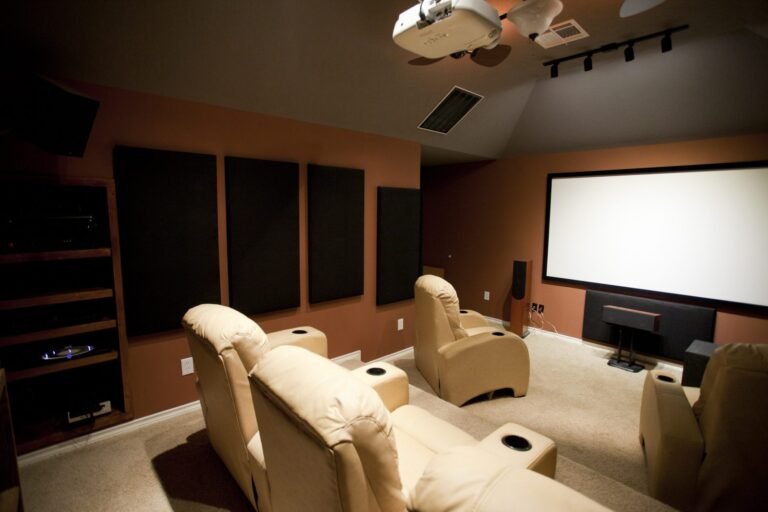
Multi-channel amplifier with HDMI switching, Dolby Atmos decoding. For home cinema 5.1, 7.1, and Atmos setups.
Class A, Class AB, and Class D: What’s the Difference?
- Class A: The purest amplifier topology – conducts current through both halves of the audio cycle at all times. Produces some of the most natural, musical sound available, but runs warm and is less efficient.
- Class AB: The most common topology – efficient, runs cooler, and sounds excellent. The sweet spot for most hi-fi systems.
- Class D: Digital switching amplifiers – highly efficient, compact, and increasingly capable of audiophile performance. Ideal for powered speakers and modern integrated designs.
Understanding Power Ratings
Amplifier power is rated in watts per channel (WPC) at a specific impedance (usually 8Ω or 4Ω). More watts means more headroom and dynamic range, not necessarily louder volume. Most home listening happens at 1–10 watts. The key is having enough power in reserve for peaks — a 50WPC amp playing at 2W has plenty of headroom; a 10WPC amp at 5W is already stressed and clipping.
Impedance matching is critical. If your speakers are rated 4Ω, your amplifier must be rated to drive 4Ω loads. Connecting 4Ω speakers to an 8Ω-only amp causes the amp to overheat and can cause damage. Always check your speaker’s impedance before buying an amp.
Matching Amp Power to Room Size
- Small room (<150 sq ft): 20–50WPC is ample with efficient speakers (90dB+)
- Medium room (150–300 sq ft): 50–100WPC provides clean dynamics
- Large room / open plan: 100–200WPC for effortless volume at any listening level
- Ceiling speakers (commercial): 100V line amps for multi-zone installations
Speaker sensitivity matters as much as room size: with efficient speakers (90dB+), the small-room band is ample, while less efficient speakers need the headroom of the higher bands to keep dynamics clean at the same listening level. And if your speakers are rated 4Ω, make sure the amplifier is rated to drive 4Ω loads, as the power section notes.
Features Worth Having in 2025
- Phono stage — built-in MM/MC phono input for turntable connection without a separate pre-amp
- DAC — built-in digital-to-analogue converter for USB and optical inputs
- Wi-Fi / streaming — Sonos Amp streams from 100+ services; Wiim Amp supports AirPlay 2
- Streaming certification — Chromecast and Roon Ready support (alongside AirPlay 2) for seamless music streaming without a separate device
- Headphone output — a dedicated high-quality headphone output for late-night listening
- HDMI ARC — connect TV audio directly to the amp without a soundbar
- Class-D — efficient, runs cool, ideal for always-on streaming amplifiers
Connecting Your Amp
Connect in source-to-amp-to-speaker order: plug your source into the amplifier first — a turntable into the phono stage, a TV or streamer into the DAC or optical input, or a TV into HDMI ARC — then connect the amplifier’s speaker outputs to your speakers. Getting this order right means every feature in the list above, from the phono stage to HDMI ARC, sits in the chain where it can actually be used.
Frequently Asked Questions
Does more watts always mean louder? Not necessarily. The power section notes that more watts means more headroom and dynamic range, not necessarily louder volume — most home listening happens at 1–10 watts, and the key is having power in reserve for peaks.
Can a 4Ω speaker run on an 8Ω-only amp? No — the guide’s impedance tip is explicit: if your speakers are rated 4Ω, your amplifier must be rated to drive 4Ω loads.
When is an AV receiver right over an integrated amp? When you are building home cinema: the AV receiver is the multi-channel amplifier with HDMI switching and Dolby Atmos decoding for 5.1, 7.1 and Atmos setups, while the integrated amp is the choice for home hi-fi two-channel listening.
Budget Guide (India 2025)
- ₹15,000–30,000: Yamaha A-S301 — reliable stereo integrated, phono stage included
- ₹50,000–80,000: Marantz PM6007 — audiophile stereo integrated with MM phono and DAC
- ₹72,000: Sonos Amp — 125WPC streaming amplifier, HDMI ARC, Wi-Fi
Shop Amplifiers at proaudiovideo.in
Sonos Amp, Marantz, Yamaha and more. Authorised dealer, Mumbai. Pan-India delivery.